Why Orange Cats Make the Very Best Friends
Norm Hacking and Kirk Elliott can tell you why.
Best friends can come in lots of shapes and sizes;
That’s why they’re always such wonderful surprises.
Mine has four legs and a lot of orange fur;
He tells me life is great with the world’s loudest purr.
His name is Syd, and when his owner moved away.
He came a-knocking at my door one day.
He said, “I sure need a home, oh, won’t you let me in?
‘Cause orange cats make the very best friends.”
Well, they’re not in it for the food, not in it for the money.
Just give their chin a scratch; let them sleep where it’s sunny.
You don’t need a turtle or a gerbil or a bunny,
‘Cause orange cats make the very best friends.
It’s been nearly twenty years since he came to stay;
He’s been my best friend in so many ways!
From a handsome young mouser to a wise old man,
Syd, the orange cat, he’s been my very best friend.
Well, they’re not in it for the food, not in it for the money.
Just give their chin a scratch; let them sleep where it’s sunny.
You don’t need a turtle or a gerbil or a bunny,
‘Cause orange cats make the very best friends.
Well, they’re not in it for the food, not in it for the money.
Just give their chin a scratch; let them sleep where it’s sunny.
You don’t need a turtle or a gerbil or a bunny,
‘Cause orange cats make the very best friends.
‘Cause orange cats make the very best friends!

Why Orange Cats Are So Special
Scientifically
If you’ve ever loved an orange cat, you already suspected they were a little different from other cats. Turns out, science agrees—and as of 2025, we finally know exactly why.
For more than a hundred years, geneticists have been stumped by orange cats. Not because orange fur itself is rare in the animal kingdom—tigers, golden retrievers, orangutans, and redheaded humans all manage it just fine. What puzzled scientists was something else entirely: in cats, and only in cats, orange coloring is tied to sex. About 80% of solid orange cats are male. Nobody could explain why, and nobody could find the gene responsible…until now.
The Mystery, Finally Solved
In May 2025, two independent research teams—one at Stanford University led by geneticist Christopher Kaelin, the other at Kyushu University in Japan led by Hiroyuki Sasaki—both cracked the case at the same time, publishing their findings simultaneously in the journal Current Biology.
What they found: a tiny deletion on the X chromosome that switches on a gene called Arhgap36 in pigment-producing cells. Here’s the wild part: this gene had never been linked to fur or skin color in any animal before. In humans, it’s associated with certain tumors and cell signaling during development. Nobody had any reason to suspect it controlled coat color, in cats or otherwise.
In most orange-colored mammals, the responsible mutation shows up in one of two well-known pigment genes—and neither of those genes lives on the sex chromosomes. Cats broke the mold entirely, evolving a totally novel genetic pathway to get their ginger color. So when people call orange cats “freaks of nature,” they’re not exactly wrong—they’re just being generous about it.
Why So Many Orange Cats Are Male
It’s All about the Chromosomes
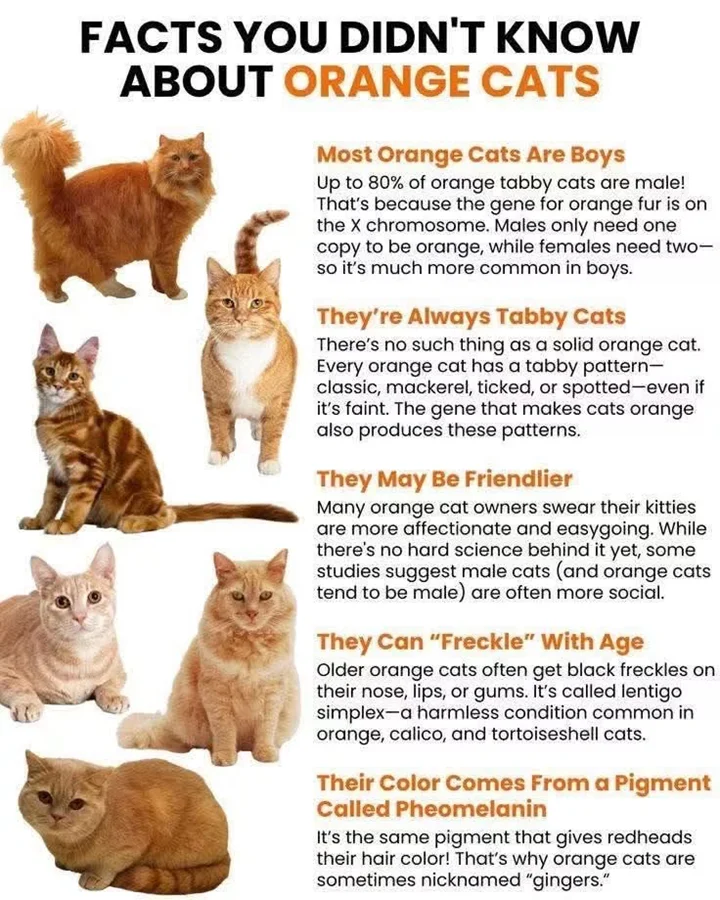
The X-chromosome connection explains the whole mystery of orange cat demographics. Male cats have one X chromosome and one Y chromosome. If that single X carries the mutation, the cat will be entirely orange—no exceptions, no in-between.
Female cats have two X chromosomes. To be fully orange, they need the mutation on both copies—which is statistically much less likely. If a female cat inherits the mutation on just one X chromosome, something else happens: early in development, each cell randomly shuts off one of its two X chromosomes. That random shutdown creates patches—some cells running the orange version, others running the black version—which is exactly how you get tortoiseshell and calico patterns. It’s basically a biological coin flip playing out patch by patch across the cat’s whole body.
An Ancient Mutation
This also means calico and tortoiseshell cats carry the very same mutation as solid orange cats—they just express it differently, and that’s why they’re almost always female. A male calico or tortoiseshell is a genuine rarity; and when it happens, it’s usually because that cat has an extra X chromosome.
This isn’t some brand-new quirk, either. Researchers found the identical mutation in orange cats sampled from widely different parts of the world, which tells them it likely arose just once—probably early in the domestication of cats—and then got passed down and selectively favored ever since. We know it’s old for an interesting reason: calico cats show up clearly in Chinese paintings dating back to the 12th century.
Historically
There is some evidence suggesting that Vikings may have favored orange cats, particularly due to their interactions with different cat breeds during their travels. Genetic studies indicate that the Vikings transported orange and white cats from their contacts in the Black Sea region to the North Atlantic.
The Vikings’ relationship with cats, especially orange ones, is intriguing.
- Traveling with cats — Vikings often brought cats on their ships to control vermin, ensuring food supplies remained safe.
- Genetic evidence — Studies show that Vikings selectively transported orange and white cats, indicating a preference for these colors.
- Cultural significance — Cats, including those with orange fur, were valued for their role in maintaining hygiene aboard ships.
- Historical distribution — Orange cats have been found in regions associated with Vikings, such as Scotland and Iceland, suggesting their presence was notable.
Psychologically

This is the part every orange cat owner really wants to know: is the “orange cat energy”—the chaos, the friendliness, the sheer nonsense—actually real?
The science here is far less settled. The Stanford team did check gene expression in the brain to see if there was a biological basis for the “orange cats are goofier” stereotype, and they didn’t find a clear difference.
Research suggests that orange male cats may enjoy greater social status.
- Orange cats are thought to be friendlier and more affectionate than other cats.
- Orange cats may be more likely to engage in risky behaviors that result in death.
- Orange male cats may enjoy greater social status and thus reproductive success in rural locations.
Research hints that size may be a factor in social dominance.
An older (2020) study looking at French cat populations proposed that orange male cats, who tend to be larger, may be more socially dominant—which could translate into bolder, more people-comfortable behavior. This research, however, was about reproductive strategy, not friendliness specifically; and it doesn’t actually explain the popular claim that orange cats are more affectionate toward humans. So for now, “tortitude” and “orange cat brain” remain more folklore than confirmed science—an amusing theory, but not a proven one.
The Takeaway
Orange cats really are one of a kind—not just in personality, but at the level of their DNA. They’re the only mammal known to get their color through this particular genetic pathway, discovered only after a century of scientists (and plenty of devoted cat owners) chasing the answer. So next time your orange cat is doing something ridiculous, you can tell him, with complete scientific backing, that he really is built different.
Sources
- Bai, Nina. 2025. “Scientists Track Down Mutation That Makes Orange Cats Orange.” Stanford Medicine News Center, May 2025.
- Kwong, Emily et.al. 2025. “The DNA Secret Behind Orange Cats.” NPR Short Wave, May 16, 2025.
- Lee, Gayoung. 2025. “This Strange Mutation Explains the Mystifying Color of Orange Cats.” Scientific American, May 15, 2025.
- Montoliu, Lluis. 2024. “Scientists Reveal Genes That Make Cats Orange.” Live Science, December 8, 2024.
- Pulu, Tibi. 2026. “Orange Cats Are Genetically Unlike Any Other Mammal and Now We Know Why.” ZME Science, June 9, 2026.
- Schupak, Amanda. 2025. “What’s So Special about Orange Cats? Turns Out They’re Freaks of Nature.” CNN Science, May 23, 2025.
- Wu, Karen. “Why Orange Cats Are So Special, According to Science.” Psychology Today, September 27, 2020.